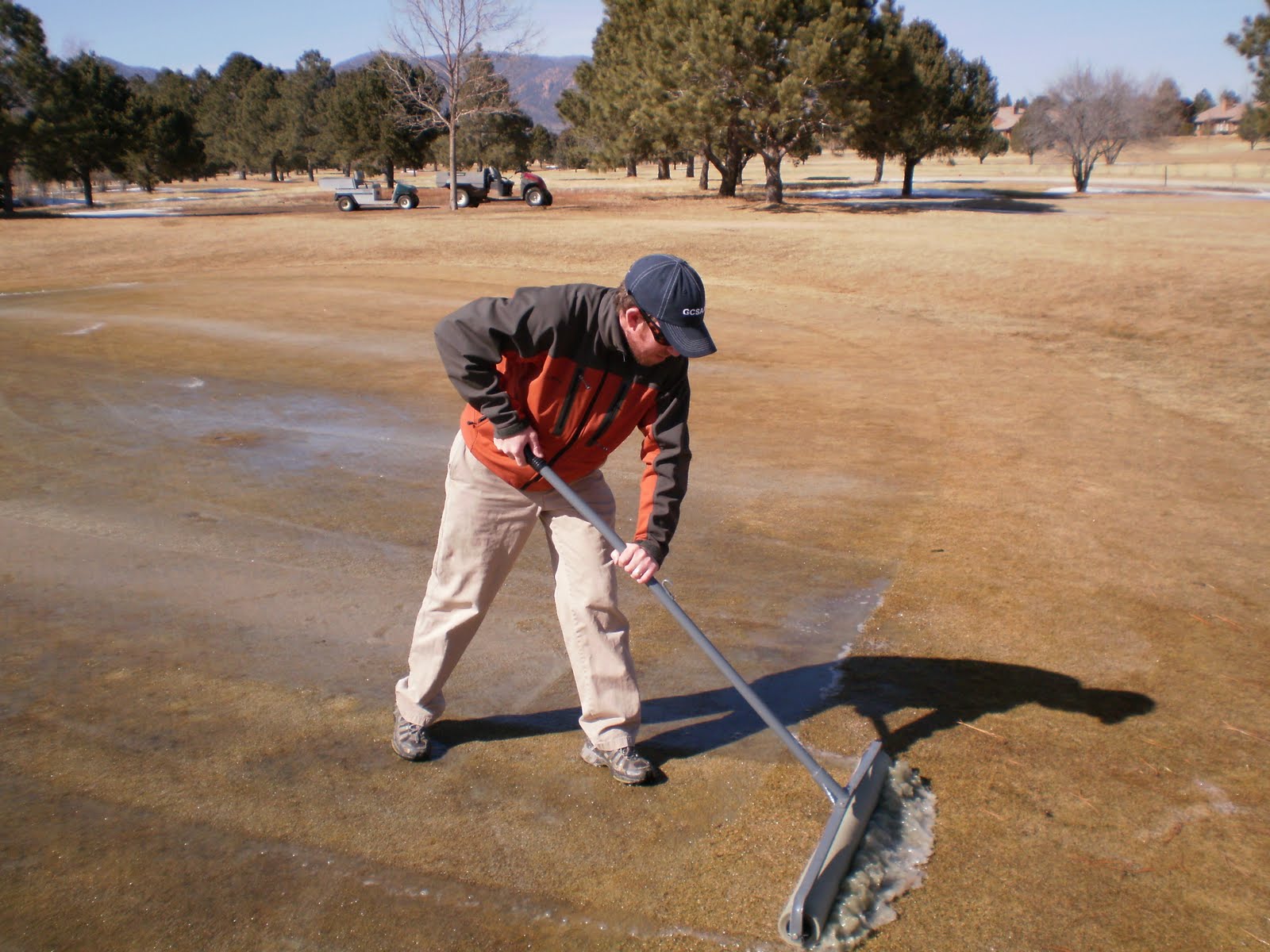
One of the drawbacks from spring conditions in Colorado is that you can never count on weather conditions to remain consistent. After months of being bogged down by snow and freezing conditions, we've been blessed with some higher daytime temperatures and somewhat comfortable playing conditions. Although snow cover is the best thing for protecting the plant during these winter months, it becomes abundantly clear when it's time to clear it from greens. In some instances, it's removal is to reduce ice build up that could be suffocating the plant from oxygen exchange, while another example would be to re-apply snow mold fungicides. In any case, the decision is usually based on a rational set of circumstances that go beyond the Greens Chairman wanting to play the golf course with his Brother-in-Law. The method of removal is typically based on golf course elevation, but can vary from course to course. In our case, huge amounts of snow are rare and can usually be manually removed if conditions warrant. My main concern in these rare instances is the build up of ice (most often in shaded areas where little to no sunlight is able to hit the green). Because the majority of our greens consist of Annual Bluegrass or (Poa), a higher susceptibility to winter damage and slower to green-up condition in the spring is usually the case. To combat winter damage, a heavy application of topdressing sand is applied to all of the greens before going into dormancy in the fall sometime around Thanksgiving. This sand application helps protect the plants from damage caused by wind and additionally acts as a blanket on the green, thereby warming the soil and promoting a faster green-up in the spring. Ice levels are assessed daily during the winter months in a proactive attempt to avoid this occurrence. If ice does build to an uncomfortable level, (symptoms including ulcer pains and the inability to sleep knowing my greens may not come out in the spring), I'll typically make a heavy application of Humates to the greens sometime in March. This application is made to darken the surface of the green and attract more ultra violet rays from the sun. This material also accelerates soil temperatures and gives us a chance to push our greens without the use of covers and is usually gone unseen by our pre-season golfers. Other Golf Course Superintendents have been known to use black sand, or even sunflower seeds for the same effect. Because of the design grade of some of the greens throughout the course, they have the tendency of holding water. Coupled by the fact that the ground remains frozen in the greens profile, and the lack of drainage in the majority of greens throughout the golf course, the surface water has no where to go and must be manually removed to reduce the potential damage from a freeze-thaw cycle. Although a huge effort is given each year to prevent this type of damage to greens, inevitably, fairways and tees are too abundant and suffer from this damage. While I've witnessed this turfgrass condition on all of the golf course, it is usually concentrated on the old holes that occupy larger trees and experience reduced wind. I suppose only time will tell where we will need to re-seed this spring........I'll have all night to think about it, I guess.


 Pictured above is the nursery plug I had taken out a while back. Each picture has been taken roughly one week after the previouse one and has continued to show us some signs of life. As exciting it is to finally see some green, I'm deeply disapointed to see how much death has occured on this green. By looking at this sample, you will notice that hardly any of the Annual Bluegrass has managed to make it through the winter. The vertical shoots represent the Bentgrass that makes up only a small percentage of this green. Seeing this gives me a pit in my stomach knowing that the majority of our older greens consist of this variety.